How to avoid fraud when buying a plot of land in Uganda
by Samuel Kagamba
Follow author on



Buying a plot of land is a decision most people will not avoid in life because it is usually considered the first step to owning a house or home. So you have made some money through your hard work and now you want to buy a plot so that you can develop yourself say build yourself a house, may be rentals or a house to stay in. The process of buying a plot in Uganda can be very fraudulent which can cause you to lose your hard earned money. I have organized for you some steps you can follow as guidelines to avoid fraud when purchasing a plot:
For a plot of land without a title:
1. Find a broker or real estate agent in the village or location where you want to buy (a local broker)
When you want to buy a plot of land in any village in Uganda, go to that village or place and ask for a broker in that area. These brokers usually have offices in the area which people are aware of. In many areas, they even advertise their services on placards or posters pinned in the junctions of roads or in the town centers. Sometimes you may personally know a broker or someone may refer a broker to you. The broker will usually know several plots for sale, which he’s able to show you for a checking fee. This fee is usually not very much, about UgX 20,000 to 30,000.
2. Visit the plot with your broker
Let the broker or the owner of the plot take you to the plot. While at the plot, please take very clear pictures of the plot with your phone or tablet for reference. You may also ask your broker to be included in the picture. This should be the only activity you should do on this day.
3. Visit the plot again the next day alone, without your broker
If you appreciated the plot the previous day and you’re interested in buying it, then stage to go back to that place the next day, but this time without the broker. Find the neighbors to that plot and ask about its ownership and also ask about whether the plot has contentions against it. This is very crucial so as to avoid buying a plot which has previously been sold or which has wrangles of a family that haven’t been sorted. Somehow the neighbors always know. The neighbors will even tell you such crucial details like whether the chairman has fraudulently sold that plot many times to several people. These people will even tell you whether their chairman is crude, fraudulent and should be dealt with carefully.
4. Find the LC1 chairperson yourself
Do not ever let the broker take you to the chairperson! On the second visit of the plot, when you haven’t come with the broker, find a boda guy in that village and tell him to ride you to the chairperson’s office. The boda guy usually never charges a lot, it’s usually not more than UgX 3000.
Once you get to see the chairman, introduce yourself and why you’re there. Tell the chairman that you have come to his office for an inquiry and immediately pay him some money for his services, usually at least UgX 20,000 asap. Tell the chairman that a broker has showed you a plot for sale in their village and then show him the pictures of the place. Ask him whether he’s aware that that plot is for sale and if he can confirm the owner of the plot which has been put for sale. Usually the chairman knows the owners of land in his village. Once the chairman has confirmed the owner and that the plot is for sale, then you can go ahead to call your broker again to make arrangements for payment in his presence. Please always remember not to double cross your broker.
5. Set the day of payment
On the day of payment, please do not come alone. Please come with a trusted witness on your side, could be a spouse, other family member, close friend or your lawyer. The transaction has to be done in the chairman’s office with both sides properly represented.
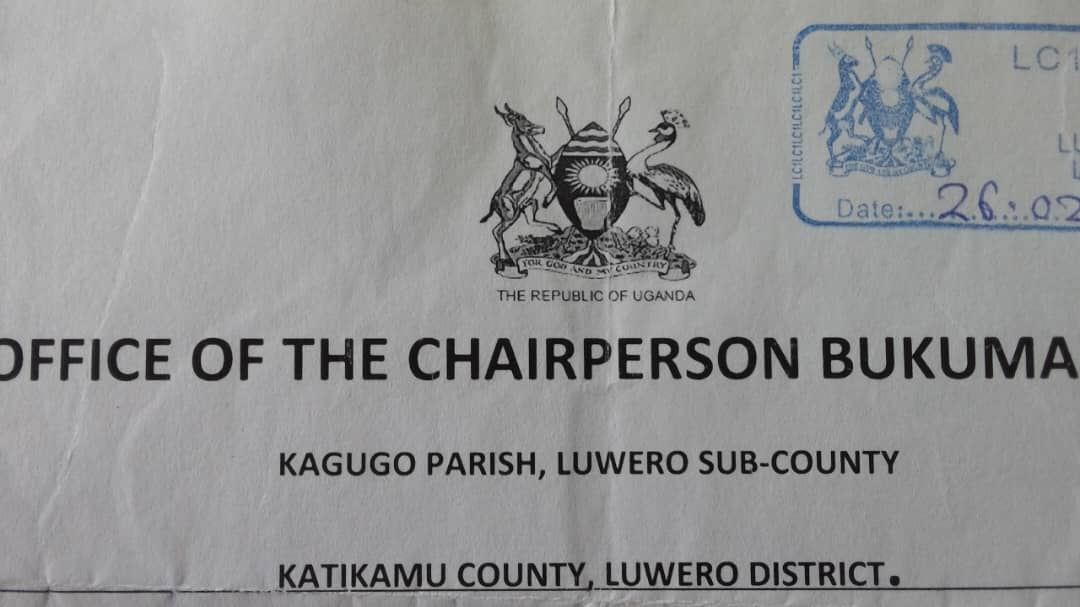
You need to be very keen on the appearance of the purchase agreement. Insist that the purchase agreement has to be written on a headed paper of the village LC1 office. If there’s no headed paper, do not proceed. You have got to tread carefully. Please take a look at an example of a headed paper of a village:
Secondly, the previous owner must present all the previous purchase agreements of that plot that they have in their original format, so that you avoid buying a plot that has already been mortgaged with a lender. If the previous purchase agreement is not available, please do not proceed.
Third, the official LC1 stamp must be available at the time of doing the transaction. If it’s not available, please do not proceed. Remember currently all official LC1 stamps are similar since the year 2019 when the government of Uganda changed and standardized them. All LC1 stamps are in the same format; rectangular in shape with the mark of the government of Uganda, with Information running from the district level to the village or cell level. Please take a look at an example of the current LC1 stamps below:
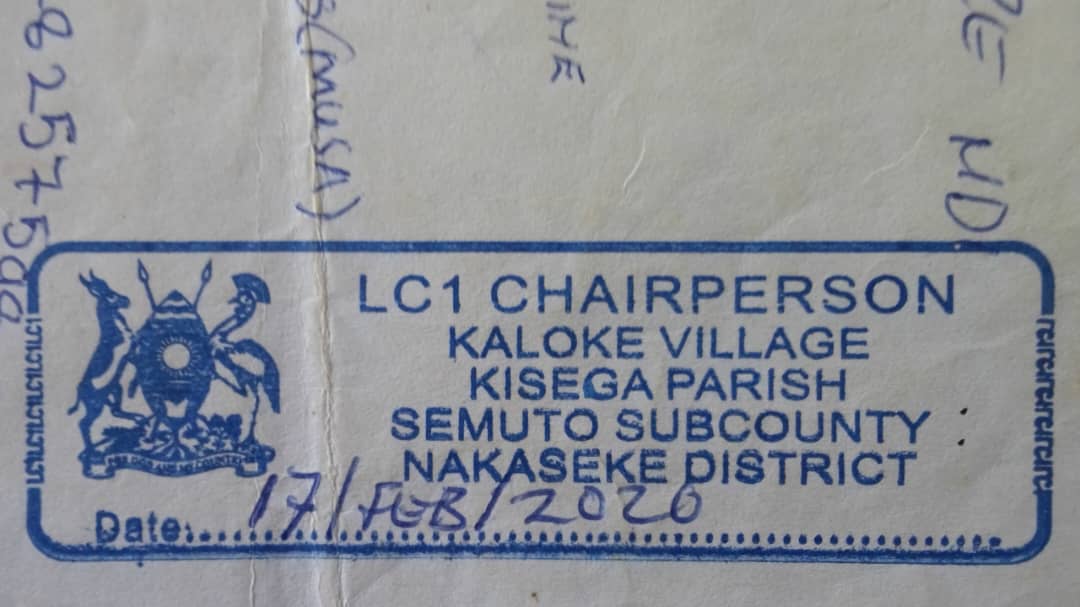
If the stamp you find in the LC1 office doesn’t appear like above, please do not proceed. That’s a fake stamp and it’s not official.
Otherwise, if everything is alright, please proceed to complete the payment and take ownership of your plot. And remember to carry the chairman’s fee for the transaction with you, this fee is mostly negotiable with the chairman. The fee could land anywhere between 2 to 7 percent of the cost of the land.
For a plot of land with a title:
1. Verify Land Ownership
One of the first steps you should take when buying a plot of land with a land title in Uganda is to verify the ownership. This can be done by checking the land title with the land registry at the Ministry of Lands, Housing, and Urban Development. Ensuring that the land title is legitimate and not forged is crucial to avoid any legal complications in the future.
2. Verify Seller's Identity
Ensure that you are dealing with the rightful owner of the land or their authorized representative. Request identification documents and cross-check them with the land title. Be cautious of anyone who is unwilling to provide proper identification.
3. Conduct a Background Check on the Seller
Before proceeding with the purchase, conduct a background check on the seller. This can include researching their reputation, checking for any past fraud allegations, and verifying their credibility in the property market.
4. Hire a Licensed Surveyor
Engaging a licensed and experienced surveyor is essential. A surveyor will help you identify the exact boundaries of the land and ensure that the plot you are purchasing is accurately represented in the land title. This will prevent issues like encroachment or disputes over land boundaries.
5. Conduct a Physical Inspection
Always conduct a physical inspection of the land before making any payments. This allows you to verify the land's location, boundaries, and any existing developments on it. Take note of any visible markers or boundary disputes with neighboring properties.
6. Avoid Cash Payments
To minimize the risk of fraud, avoid making cash payments for the land. Opt for bank transfers or other traceable payment methods. This provides a record of the transaction, which is useful in case of disputes or legal issues.
7. Secure All Necessary Documents
Ensure that all necessary documents, such as the sale agreement, transfer forms, and proof of payment, are properly signed and secured. Keep copies of these documents for future reference.
8. Be Patient and Thorough
Rushing into a land purchase can lead to costly mistakes. Take your time to thoroughly investigate every aspect of the transaction, seek professional advice, and ensure that everything is in order before committing to the purchase.
With the guidance given in the above steps, I hope that you’re now warmly equipped to go into your next transaction of purchasing a plot in Uganda, efficiently avoiding fraud.
Please note that you may always need to check with your own village Lc1 council and Ministry of Lands for clarification and further guidance.
In case you need to get a loan to push you forward, feel free to reach out to us for assistance direct on our phone number +256 760082017. You may even check out our loan products to see what could suit you .We also provide guidance on how to safely transfer money between Uganda and other countries.
Share this article:
Subscribe to receive our blog posts every time they're out!
Follow Us on Social Media